No country is immune to complex forest fire situations, characterised by simultaneous outbreaks, rapid spread, high intensity, and complex behaviour, posing significant challenges to their management and suppression. These fires interact and can modify the weather conditions in the area, further complicating fire suppression operations and planning. Furthermore, they are affected by global change (climate and socioeconomic), which favours the circumstances and factors that lead to their outbreak and spread.
Therefore, at the end of May, representatives from Paraguay, Uruguay, Chile, Mexico, Ecuador, Colombia, Brazil, Peru, and Bolivia participated in a meeting to combat these highly severe fires and adopt an Integrated Fire Management approach, focusing not only on firefighting but also on fire prevention, landscape management, and understanding fire and its behavior, including how rural and indigenous communities use it.

The course has been organised by the European Union through the Amazon+ Program, in the context of the activities of the Group of Experts on Forest Fires (GEFF LAC) that brings together experts on forest fires from countries in South America and Mexico to exchange knowledge and good practices in Integrated Fire Management. Amazon+ is an initiative designed to support Amazonian countries in reducing CO₂ emissions, adapting to climate change, and protecting biodiversity. In this framework, FIAP, a Spanish cooperation entity specialised in strengthening public policies, has mobilised experts from the Forest Fire Assessment and Advisory Team (FAST) of Spain, coordinated by the Ministry for the Ecological Transition and the Demographic Challenge, and instructors from the Pau Costa Foundation.

Integrated Fire Management
This course is part of an effort to strengthen regional technical capacities within the framework of Integrated Fire Management. Throughout the week, participants have been trained in analytical tools that enable them to interpret the dynamics of fires, model their possible evolution, and make strategic and tactical decisions based on technical, meteorological, and safety criteria. The ultimate goal is to share a vision of the behaviour and movement of forest fires and to create a common model of analysis.
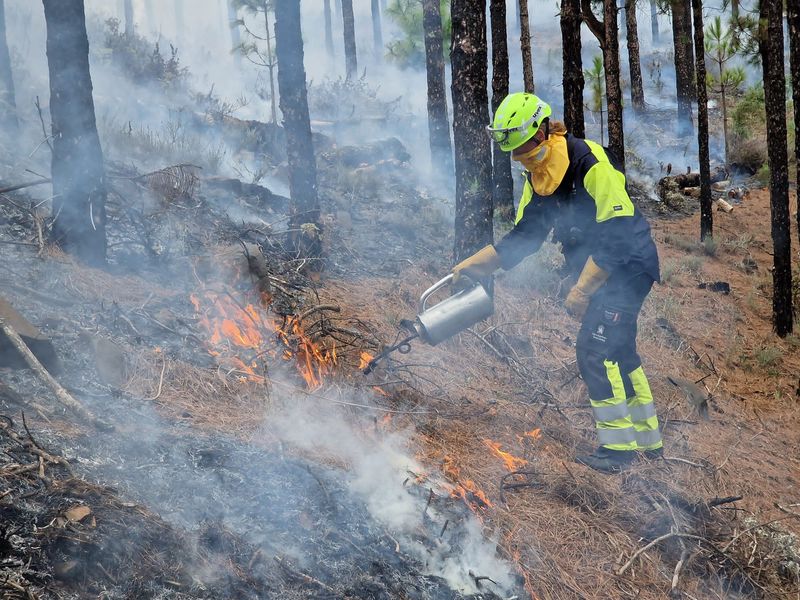
Likewise, the understanding of fire is promoted not only as a threat, but as an element present in many socio-ecological systems. Understanding the traditional uses that peasant and indigenous communities make of fire – and how to integrate them into land management – is an essential part of an adaptive, culturally relevant and environmentally effective approach.
A particularly critical reality in Bolivia
Bolivia has faced the worst forest fire season in its history in 2024. According to official data, more than 12.6 million hectares were burned, representing approximately 11.5% of the national territory. Of this area, 7.2 million hectares corresponded to forests and 5.4 million to pastures, seriously affecting vital ecosystems and indigenous communities.
The department of Santa Cruz was the most affected, followed by Beni and La Paz. The magnitude of the crisis led the Bolivian government to declare a national emergency on September 7 and a national disaster on September 30, 2024. The consequences were devastating: loss of biodiversity, impact on protected areas, displacement of communities, interruption of economic activities and levels of air pollution that reached categories.