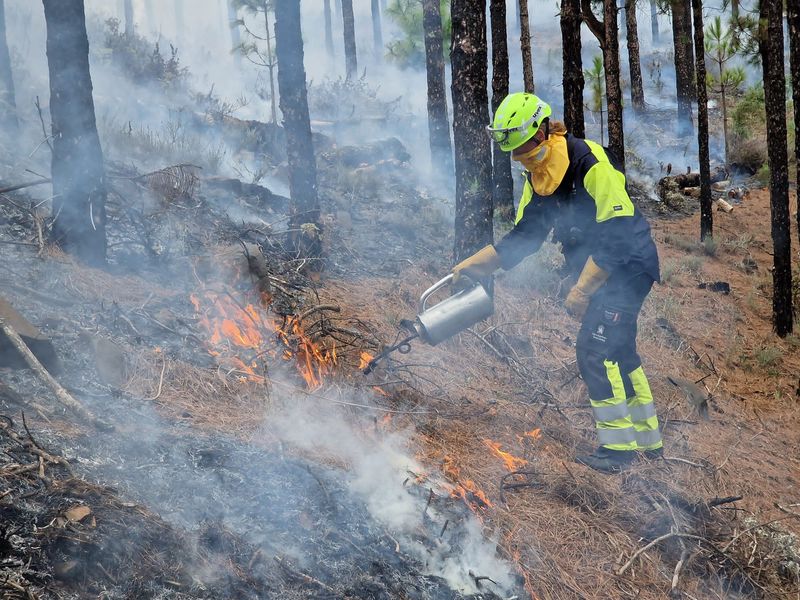
The Bio For Piri project, led by the Fundació Catalunya La Pedrera in coordination with the Pau Costa Foundation and four other partner organisations, ends after two years with results that confirm its social, economic, and environmental impact, as well as its potential as a replicable model.
In response to the fragility of the Pyrenees—caused by the abandonment of agricultural and livestock activities, which has led to increased forest biomass and the creation of continuous forest areas highly vulnerable to wildfire—Bio For Piri has embraced an innovative strategy: turning the risk of large forest fires into a driver of change. Forest bioeconomy is the key to revitalising the territory, creating jobs, and making forests more resilient.
Bio For Piri has worked in two intervention areas—Alinyà (Alt Urgell, Lleida) and Aïnsa-Sobrarbe (Huesca)—with a clear vision: to care for forests, reduce risk, and promote new activities that keep the territory alive. It is a virtuous cycle that combines naturalistic and adaptive forest management, wildfire risk management, and socio-economic revitalisation.

Project impact in figures
The results of Bio For Piri can be explained through its impact in three different areas: social, economic, and environmental.
Social impact:
- Participation of 76 people and 26 administrations, organisations, and companies involved in the project.
- Estimated communication reach of 20 million people.
- 428 direct beneficiaries of the activities carried out.
- Organisation of 2 bioblitzes (citizen science events) with the participation of 58 people.
- Celebration of 17 volunteer days, bringing together a total of 105 participants.
Economic impact:
- Acquisition of 7 new biomass supply clients, including the local health centre (CAP), the municipal sports centre, the municipal music schools of La Seu d’Urgell, and a local pig farm.
- Construction of 1 prototype rural dwelling using local wood, in collaboration with IAAC.
- Delivery of 2 editions of the forestry labour course, with a total of 16 participants, 13 of whom obtained the European ECC1 chainsaw operator certification.
- Creation of 6 forest-related jobs.
- Organisation of 4 knowledge-transfer seminars on naturalistic forest management, with around 87 participants.
- Development of 8 environmental packages designed to attract private investment for the promotion of the forest bioeconomy, while helping companies meet their sustainability goals. Over the two years, 25 companies from Catalonia and Aragon have shown interest in Bio For Piri’s activities.
Environmental impact:
- Planning of 72,356 hectares of forest for wildfire risk management.
- Management of 233.4 hectares of forest using naturalistic silviculture methods.
- Management of 39 hectares of pastures to promote extensive livestock farming.
- Creation of 11 water points for livestock.
- Construction of 1 water tank for firefighting teams.
- Maintenance of 25.9 kilometres of forest roads.
- Installation of 5 interactive trails in the Aïnsa-Sobrarbe area, allowing visitors to learn more about the surrounding forests.
- Implementation of 12 biodiversity enhancement actions within strategic wildfire prevention areas.

Final conclusions
After two years of work, the Bio For Piri approach has been validated and has shown great potential. It is a project that works and can be replicated in other territories.
The project has generated important lessons, such as the fact that supporting a network of small-scale operations is the most sustainable way to strengthen local roots and revitalize the territory. It has also shown that local wood has significant potential to increase its added value in areas like bio-construction, becoming a key asset for regional development.
However, economic revitalisation alone is not enough to promote rural repopulation. It has been shown that this challenge goes beyond the project’s scope. Enhancing the role of women and ensuring access to housing and land, for example, are crucial factors in addressing demographic challenges.
Project partner organisations
This initiative is led by the Fundació Catalunya La Pedrera in coordination with the Forest Science and Technology Centre of Catalonia (CTFC), the Bearded Vulture Conservation Foundation (Fundación para la Conservación del Quebrantahuesos), the Empresa y Clima Foundation, the Integra Pirineus Foundation, and the Pau Costa Foundation.
Bio For Piri is supported by the Fundación Biodiversidad of the Ministry for the Ecological Transition and the Demographic Challenge (MITECO), within the framework of the Recovery, Transformation and Resilience Plan (PRTR), funded by the European Union – NextGenerationEU.