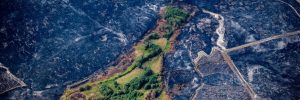
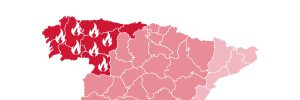
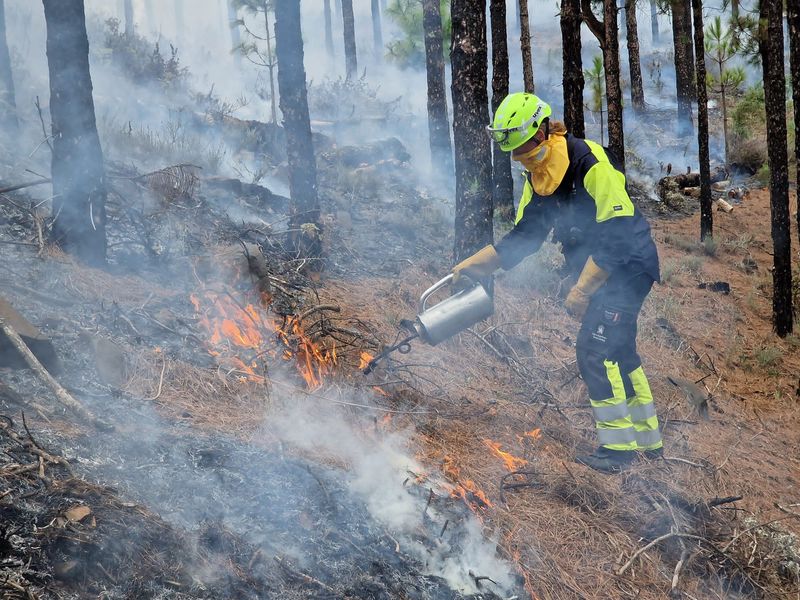
Spain is currently facing an unprecedented forest fire crisis in its recent history. So far in 2025, across Spain, more than 400,000 hectares have been burned by fire—an area larger than the island of Mallorca—far exceeding the record set in 2022, when around 260,000 hectares were burned. Added to this situation is the cost of human lives lost and environmental impact. The number of incidents is also higher than that recorded in 2022, confirming that the current situation is even more serious, with more frequent, more intense, and more difficult-to-control fires.
Given this reality, under the leadership of the Pau Costa Foundation and together with experts from the forest fire community, we held a press conference on September 4th at the Madrid Press Association (APM) to present the necessary action proposals to address major forest fires. The proposals were presented by Arantza Pérez de Oleaga (Vice-Dean of the Official College of Forestry Engineers), Juan Picos (researcher, University of Vigo), Marta Corella (Vice-Dean of the Official College of Technical Engineers), Luis Berbiela (Vice-President of the Pau Costa Foundation), Ferran Dalmau (forestry engineer, director of Medi XXI GSA), Marc Castellnou (Head of GRAF – Bombers de la Generalitat de Catalunya), Joaquín Ramírez (forestry engineer, executive director of Tecnosylva), Mónica Parrilla de Diego (Forestry engineer, responsible for forest fire campaigns at Greenpeace Spain), Enrique Segovia (Conservation Director of WWF Spain), and Virginia Carracedo (Researcher, University of Cantabria).

The action proposals are based on the conclusions of the “Forum for Debate and Action Proposals for the Management of Large Forest Fires in Spain” (Madrid, 2023), which brought together 58 experts from the fields of forest fire suppression, forest management, research, conservation, the primary sector, and civil society. The result of this work was a consensus document that defines the measures needed to transform the way Spain manages forest fires.
“Since then, nothing agreed upon in 2023 has translated into political action. The forest fire community has reached a broad technical and social consensus, we have made our knowledge and experience available to the administrations, and we continue to offer support to turn these proposals into public policies. But the most important thing is missing: the political will to act,” comments Jordi Vendrell, director of the Pau Costa Foundation.
The action proposals presented are structured into seven areas of action: forest ecosystem management to promote more resilient and sustainable forests, with structures that limit fire intensity; territorial planning to design diverse and resilient landscapes that reduce vulnerability and facilitate firefighting efforts; living rural communities to strengthen the primary sector as a guarantor of less vulnerable landscapes with greater socio-environmental value; fire use and ecology to recover fire as a natural process and management tool, through prescribed and planned use; communication, education, and awareness-raising to provide society with the tools and knowledge to learn to live with fire; knowledge and firefighting: strengthening the capacity of emergency response teams, promoting research, and creating a fire observatory; and future scenarios: preparing society and the region to live with inevitable extreme events in the context of climate change. These axes are complemented by three essential cross-cutting dimensions: policy and governance (shared responsibility of all stakeholders), nature conservation (ensuring compatibility with biodiversity), and adaptation to climate change (ensuring the resilience of ecosystems and society).
Among the proposed measures are, for example, investing at least €1 billion per year to manage 1% of the national forest landscape (260,000 ha) annually; maximizing self-protection in wildland-urban interface areas with self-protection planning and management in at least 25% of all wildland-urban interface areas in Spain; avoiding depopulation by supporting a living and sustainable primary sector, which offers opportunities for extinguishing large fires; and promoting the use of fire as a key tool for generating landscape heterogeneity, restoring biodiversity, and maintaining ecosystem services, among others.
“What is clear is that we cannot be carried away by temporary measures that seek only immediate political gain. Forest fires require state policies, sustained over time and oriented toward the common good. Relying on quick fixes or media-driven announcements is not only ineffective, but also delays the implementation of the structural measures the country urgently needs,” concludes Jordi Vendrell.