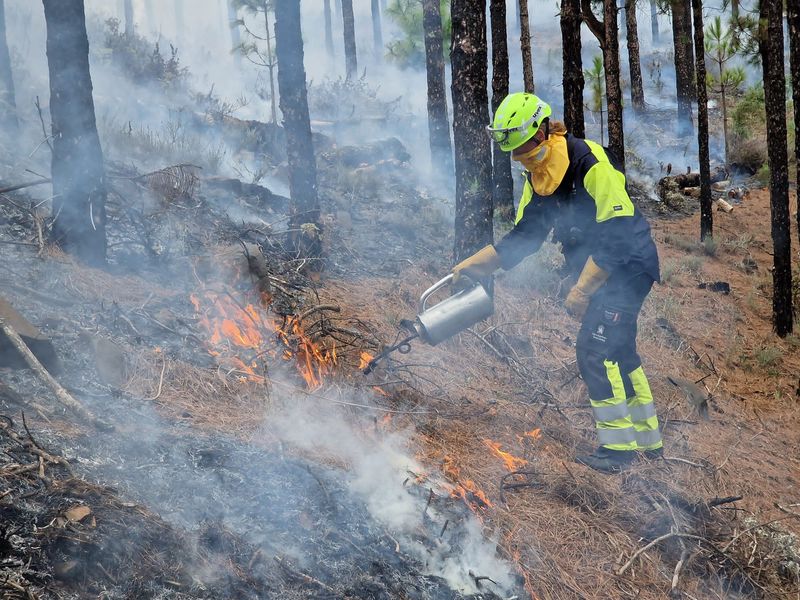
The Mediterranean is facing two major challenges due to climate change: extreme wildfires and droughts. These phenomena have devastating effects on the landscape, biodiversity, society and the economy. In particular, they pose a serious threat to the agricultural and forestry sectors. Practical solutions to enhance the resilience of the territory to extreme fires and droughts are essential to guarantee the livelihood of thousands of people.
In this sense, the European projects ResAlliance, in which we participate, and Life eCOadapt50 have joined forces to organise the event “Territory and resilience: Fair of good agricultural and forestry practices”, which was held on 16 and 17 May at the Cava Centre in Sant Sadurní d’Anoia. The fair aimed to generate a space to give visibility to the initiatives and solutions that are being developed in various parts of the Catalan territory to adapt the landscape and economic activities to climate change; that can be replicated in other parts of Catalonia or that could potentially be implemented in the coming years.
‘The synergy between Life eCOadapt and ResAlliance was established as a result of coinciding in various activities and sharing the goal of adaptation to climate change. Life is a project focused on promoting the execution of actions to achieve this objective and can take advantage of the knowledge generated by ResAlliance, and ResAlliance can offer a space where some of the proposed actions can be carried out through eCOadapt50,’ explains Núria Parpal, coordinator of Life eCOadapt50 and head of the Local Environmental Planning Section in the Technical Office for Climate Change and Sustainability of the Climate Action and Energy Transition Area of the Barcelona Provincial Council.

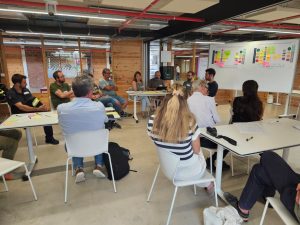
‘Territory and resilience’ has been a dynamic space where the promoters of 38 innovative practices from agriculture, forestry, agrisilvopasture and tourism have shared their experiences directly with a hundred participants, including representatives of the public administration interested in promoting actions in the territory to promote its resilience.
During the two days of the fair, those responsible for the territory’s resilience practices held two rounds of presentations of their solutions, followed by a space for discussion with the participants. In this way, attendees had the opportunity to learn about all the practices of the day from their promoters in a close and interactive way. The 38 practices that were presented included sustainable food production through regenerative agriculture (The Regen Academy); the transformation of local wood into sustainable materials (Forestry Hub of Catalonia); support for entrepreneurs to develop their livestock activity as a forest management tool (Ges Valley Test Area); or the creation of local product brands (Cigronet de Senan), among many others.
In addition, the first day’s programme included demonstrations of two initiatives: MeFiTu (Foundation’s Resilient Landscapes and Societies Area), our environmental education workshop focused on landscape management to reduce wildfire risk; and the programme for the improvement of vineyard soils of the Department of Agriculture, Livestock, Fisheries and Food of the Generalitat de Catalunya.

‘I think the most remarkable thing about the fair is the massive response of the promoters of solutions who have wanted to participate and show their initiatives, 40 in total! This shows the willingness of the actors of the territory to seek solutions to improve the resilience of the landscape from the agricultural, forestry and tourism sectors. It is also important to highlight the diversity of profiles that participated in the fair, from the worlds of research, public administration, the private sector/business and associationism, among others,’ says Mariona Borràs, ResAlliance LandLab coordinator, Catalonia LandLab ambassador, and head of the Membership and Community Engagement Area of the Foundation.
Within the framework of the ResAlliance project, this is the third event organised by the LandLab of Catalonia, made up of the Foundation, the Forest Science and Technology Centre of Catalonia and the Institute of Agrifood Research and Technology. The first event, in October 2023, consisted of a workshop where actors from the three areas of work of this LandLab (Baix Llobregat, the eastern half of L’Alt Penedès and the southeast of L’Anoia) identified challenges and needs that had to be addressed. The second, in May 2024, brought together actors from Catalonia, Sardinia (Italy) and the Northern Region (Portugal), to exchange good practices for improving landscape resilience in these regions.
The next action of the Catalan LandLab is a field trip on May 27 in the municipality of Aiguamúrcia to visit two of the initiatives that were presented in ‘Territory and resilience’: the role played by microbiology in the natural fertility of the soil and the vitality of crops, and the silvicultural treatments that are being carried out near the Monastery of Santes Creus to transform an Aleppo pine forest into an agroforestry system (agenda and registration, here).
More information about ResAlliance
- • Those interested in the activities of the Catalonia LandLab and the Mediterranean network of actors in landscape resilience of ResAlliance (LandNet) can access all its opportunities and resources for free here.
- Web
- LinkedIn: @ResAlliance
- Facebook: @ResAlliance