The EWED project (Extreme Wildfire Events Data Hub for Improved Decision Making ) officially concluded on 31 December 2025, after two years of collaborative work aimed at strengthening Europe’s preparedness and response to extreme wildfires. Funded by the European Union under the UCPM 2023 KAPP call, EWED set out to improve understanding and operational capacity around Extreme Wildfire Events (EWEs) by bringing together empirical data, advanced science and operational expertise.
EWEs are becoming more frequent and severe across Europe, yet they remain low-frequency, high-impact phenomena that are difficult to anticipate and manage—especially for organisations with limited experience dealing with such events. Prior to EWED, there was a clear gap between scientific research on the fire–atmosphere interaction and the operational needs of emergency response organisations.
EWED addressed this gap by explicitly connecting academic research with operational practice. The project focused on generating empirical evidence from real fires, translating scientific insights into practical tools, and fostering collaboration across disciplines and sectors. This approach seeks to reduce uncertainty in decision-making during complex wildfire events.
“EWED has been a pioneering project in the study of fire–atmosphere interactions. By focusing on this complex relationship, the project has generated new knowledge and key tools that help reduce uncertainty when dealing with Extreme Wildfire Events,” says Jonathan Troncho, EWED Project Coordinator at the Pau Costa Foundation.
Over its two-year duration, EWED delivered a comprehensive set of outputs designed for both operational and academic audiences. These include:
- The Wildfire Data Portal, the first open-access database compiling fire behaviour data at both surface level and in the vertical atmospheric profile, computer models, and 3D wildfire simulations.
- Standardised data collection protocols for Extreme Wildfire Events.
- Training and capacity-building materials.
- Scientific publications advancing knowledge on EWE dynamics.
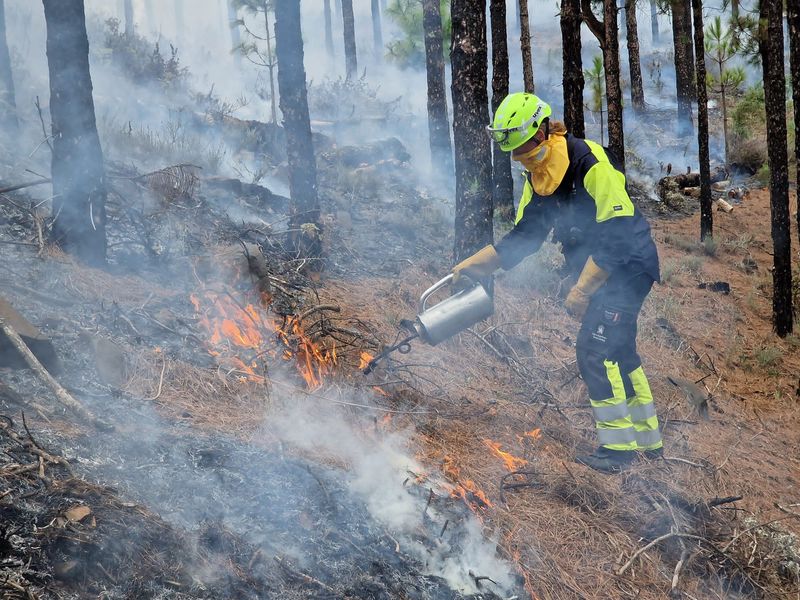
All outputs are openly accessible through the EWED website and the Wildfire Data Portal, ensuring their availability and usability beyond the lifetime of the project. Data hosted in the portal were collected by wildfire practitioners during wildfires and prescribed burns across Spain, Greece, the Netherlands and Chile, providing a unique empirical basis for understanding extreme fire behaviour.
Coordinated by the Pau Costa Foundation, EWED brought together a multidisciplinary consortium that included fire services, public safety institutes, universities and non-profit organisations, combining operational expertise with scientific excellence. PCF ensured strategic alignment across the project, expanded networks across disciplines, and contributed technical input across scientific, operational and communication activities.
“EWED is not just another project. It represents a concrete step towards improving capacities in wildfire emergency management by bringing academics and practitioners together around a clear need and shared objectives,” highlights Jonathan Troncho.
While EWED has formally concluded, its impact is designed to continue. Building directly on EWED’s outputs and lessons learned, the new EU-funded project ODET (Open Decision-Making System for Enhancing Europe’s Preparedness and Response Capacities to ExTreme Wildfires) will start in March 2026.
ODET will focus on the operational uptake of EWED’s knowledge and tools, integrating empirical data, advanced fire–atmosphere models and user-centred decision-support systems into emergency management processes. By combining real and virtual wildfire scenarios, forecasting extreme fire behaviour and providing targeted capacity-building tools, ODET will help translate EWED’s scientific advances into practical, day-to-day decision-making support for emergency responders across Europe.
“ODET will build on and expand EWED’s results to ensure that the knowledge and tools developed are effectively integrated into operational decision-making,” concludes Jonathan Troncho.
Together, EWED and ODET mark a continuous pathway—from data and science to operational impact—towards a more prepared, interoperable and resilient Europe in the face of Extreme Wildfire Events.